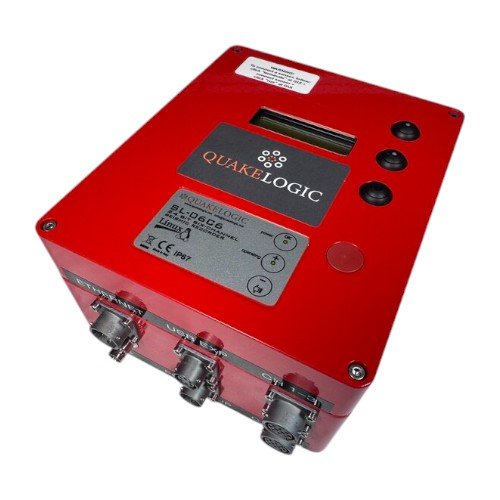
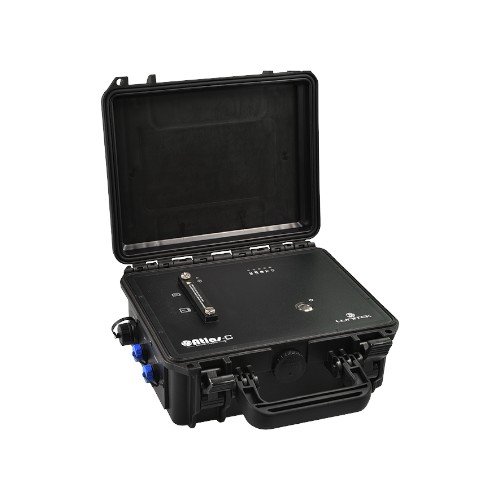
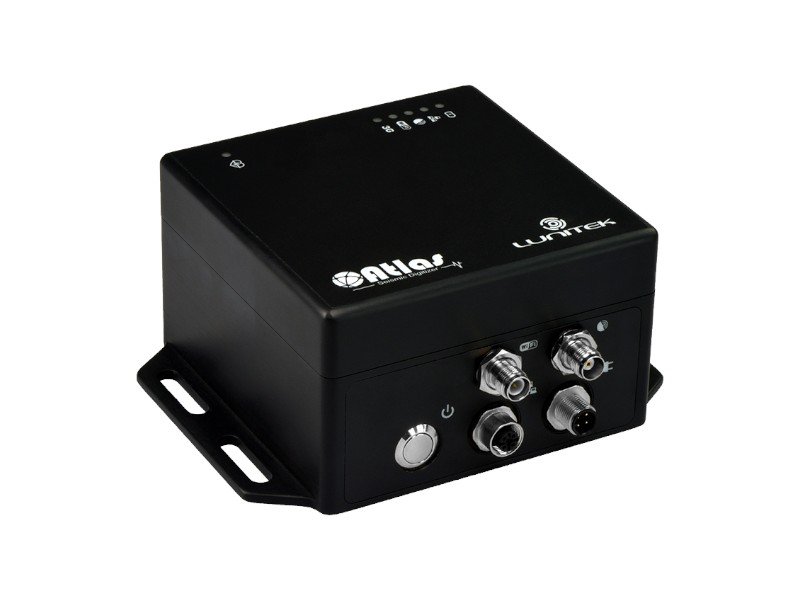
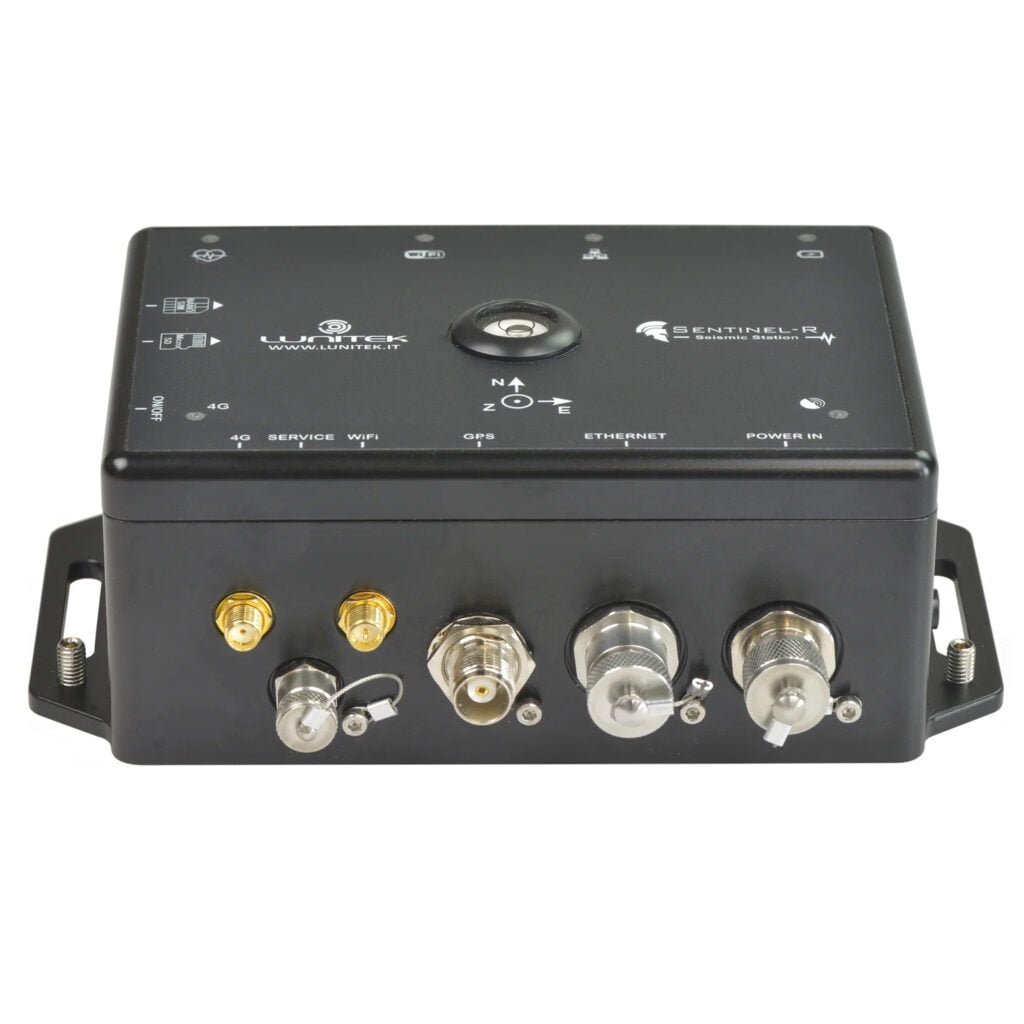
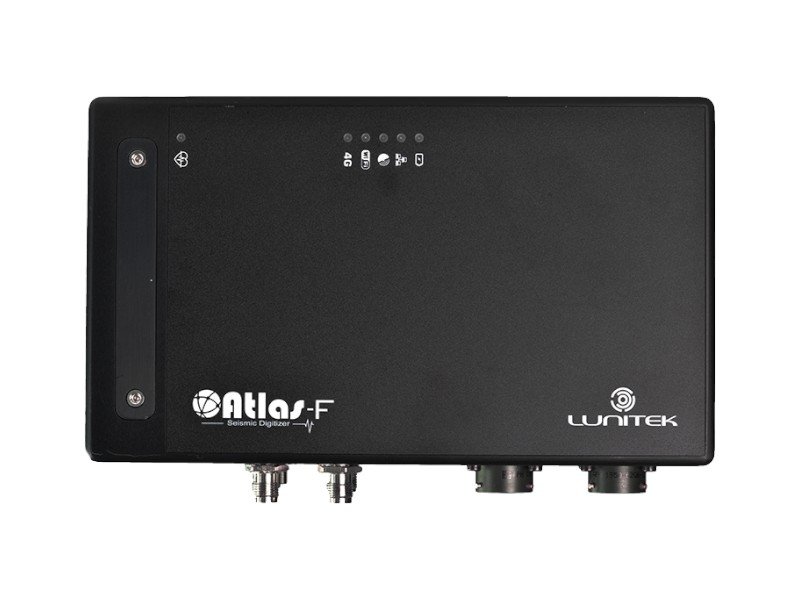
ATLAS-F – A rugged, high-performance seismic recorder featuring 32-bit ADCs, >136dB dynamic range, up to 1000 sps sampling, and 1TB dual-zone memory. With hot-swappable batteries (40-hour backup), GNSS synchronization, LAN, WiFi, 4G connectivity, and IP67 protection, it ensures uninterrupted, precise seismic monitoring in any environment.
$4.326,00 – $6.331,00Price range: $4.326,00 through $6.331,00
Rugged. Intelligent. Built for the Field.
The ATLAS-F is the next-generation evolution of the renowned ATLAS Digitizer, designed in direct response to customer feedback for greater accessibility, portability, and extended field operation. It combines high-precision seismic data acquisition with unmatched usability — making it ideal for long-term, continuous monitoring in any environment.
The ATLAS-F improves upon the standard ATLAS model with:
Removable SD & SIM card slots – Fast and easy access to data and mobile networks.
Hot-swappable dual-slot batteries – Swap batteries on the fly without powering down.
All connectors on one side – Simplified cabling for cleaner, compact installations.
Optimized for portability and long-term deployment, the ATLAS-F is engineered for field professionals who demand durability and uninterrupted performance.
Air-Travel Compliant – Batteries can be detached and carried safely in the cabin.
Continuous Operation – Dual hot-swappable batteries enable 24/7 monitoring.
Flexible Channel Configurations – Choose from 3, 6, or 9 differential inputs (optional 4 or 8).
✔ 32-bit Delta-Sigma ADCs – Ultra-high-resolution synchronized acquisition.
✔ Dynamic Range >136 dB @100 sps – Exceptional clarity and noise suppression.
✔ Adjustable Sampling Rate – 1 – 1000 sps per channel for maximum versatility.
✔ 1 TB Dual-Zone Storage – Continuous ring-buffer plus event-triggered recording.
✔ MiniSEED Format – Fully compatible with standard seismic workflows.
✔ GNSS Time Sync – Absolute timing accuracy across multi-station networks.
✔ LAN, Wi-Fi & Optional 4G Modem – Local or remote data access anytime.
✔ User-Accessible Micro-SIM Slot – Simplifies mobile network setup.
✔ SeedLink Protocol Support – Works seamlessly with SeisComP3, Antelope, Earthworm, Geopsy, and Seisgram2K.
✔ 40-Hour Built-In Battery Backup – Uninterrupted recording during outages.
✔ 9–28 V DC Input – Supports AC, solar, or external battery systems.
✔ Sensor & Modem Power Backup – Keeps the entire monitoring chain alive.
✔ CNC-Milled Anodized Aluminum Housing (optional INOX AISI 316 version) – Rugged, vibration-resistant, and fully IP67 weatherproof.
✔ Built to withstand harsh outdoor conditions, from remote desert stations to offshore structures.
32-bit ADC with >136 dB dynamic range
Adjustable 1–1000 sps sampling rates
LAN / Wi-Fi / 4G data transmission
GNSS time synchronization
Integrated UPS with 40-hour backup
MiniSEED format compatibility
Permanent seismic monitoring networks
Structural health monitoring (SHM)
Aftershock and volcano observation arrays
Bridge, dam, and building instrumentation
Educational and research laboratories
The ATLAS-F combines scientific-grade performance with true field practicality. Whether you’re a seismologist, engineer, or researcher, ATLAS-F ensures reliable, continuous, and precise monitoring — anywhere on Earth.
| Weight | N/A |
|---|---|
| Dimensions | N/A |
| TYPE | ATLAS-F (3CH), ATLAS-F (6CH), ATLAS-F (9CH) |
The ATLAS-F Field Digitizer is engineered to meet diverse monitoring requirements — from short-term experiments to long-term, permanent installations. Its rugged design, flexible configuration, and advanced connectivity make it an ideal solution for seismic, geophysical, and structural health monitoring (SHM) applications worldwide.
The ATLAS-F can operate with either accelerometric or velocimetric sensors, adapting to the user’s specific project needs.
Configuration is simple — connect via Wi-Fi or LAN for in-situ setup and calibration.
For permanent monitoring, ATLAS-F offers multiple remote-access options:
Built-in 4G modem for cellular connectivity in the field
LAN connection for integration with external ADSL or network modems
This flexibility ensures uninterrupted data transmission and easy control, even from remote locations.
The ATLAS-F is perfectly suited for monitoring large structures such as bridges, dams, and industrial facilities where multi-sensor data acquisition is required.
Each ATLAS-F unit supports up to 9 fully synchronized input channels, allowing simultaneous acquisition from multiple sensors.
When more channels are needed, additional ATLAS-F units can be connected and synchronized with a MASTER device for networked operation.
Remote access is available through Wi-Fi, LAN, or the built-in HSPA/4G modem, ensuring seamless data collection across distributed systems.
The ATLAS-F is widely used in structural monitoring applications to determine the resonant frequency and dynamic behavior of buildings and infrastructure.
Custom firmware developed by Lunitek (based on Fast Fourier Transform – FFT) allows real-time assessment of a structure’s health by continuously evaluating vibration patterns and frequency changes.
In a geophysical monitoring station, the ATLAS-F is typically paired with:
A low-noise, force-balance triaxial accelerometer, and
A triaxial velocimeter, both installed on a concrete base for stability.
Each sensor’s output is digitized using high-accuracy, high-dynamic-range ADCs, ensuring precise signal capture.
The ATLAS-F can also include auxiliary analog and digital inputs to:
Record environmental data (temperature, humidity, pressure)
Detect external events (e.g., vault open/close)
Activate alarm outputs when pre-set thresholds are exceeded
Supports both short-term tests and long-term permanent installations
9 synchronous input channels per unit; scalable via Master–Slave synchronization
Wi-Fi, LAN, and 4G connectivity for local or remote operation
Real-time FFT-based analysis for structural health diagnostics
Auxiliary inputs/outputs for environmental and event monitoring
ATLAS-F models available
Answer:
Yes. The ATLAS Digitizer can handle both real-time data streaming and event-triggered recording at the same time. For accelerometer applications, we recommend using a threshold exceedance trigger instead of the traditional STA/LTA method for more reliable results.
Answer:
Absolutely. The ATLAS uses the SeedLINK protocol, which includes a ring buffer (default size: 1 GB, expandable) that can store several days of continuous data.
If telemetry is interrupted, the client can request data starting from the last received packet, and all missing records will be automatically recovered.
Even when telemetry is down, the ATLAS continues saving data locally in a dedicated folder. Once the connection is restored, the SeedLINK server automatically detects and updates the ring buffer to ensure no data is lost.
Answer:
Yes, this is possible in two ways:
Same LAN segment: When multiple ATLAS units are connected to the same network, one device can broadcast a trigger signal to all others for synchronized activation.
Different LAN segments: If the devices are separated by gateways, a Linux-based module can be used to manage communication between devices, receive trigger alarms, and execute a trigger voting algorithm for synchronized action.
Answer:
Event files are saved in MiniSEED format, identical to continuous recordings.
For advanced processing, QuakeLogic’s Event Watchdog software can be installed on a remote server to automatically transfer event data, convert files to ASCII, or extract specific time windows for further analysis (for example, with LabVIEW applications).
Answer:
The ATLAS communicates with remote servers (Linux-based systems) using MQTT and SeedLINK protocols. The remote server:
Stores continuous data from all ATLAS units,
Receives event-triggered data through MQTT or extracts it from the continuous buffer, and
Exports the relevant time window in MiniSEED or ASCII formats.
This setup enables reliable, automatic data management and integration into seismic or structural monitoring networks.
Answer:
Yes. The ATLAS can be powered by a 12 V solar panel (minimum 100 W) for autonomous field operation.
A complete solar setup typically includes:
12 V solar panel
12 V backup battery
Solar charge controller
QuakeLogic can supply the full auxiliary power package, including on-site installation and configuration for remote deployments.

Effective date: 16 May 2019
This web site (the “Site“) is owned and operated by QUAKELOGIC (“we“, “us” or “our“).The use of this Site and the content and information available on this Site (collectively the “Services“) shall be subject to acceptance of and compliance with the terms and conditions set forth in these terms of use (collectively, the “Terms of Use“) and elsewhere on this Site. The terms “you,” “your“, “yours“, “member” “members” and “yourself” refer to all visitors/members to this Site. Your agreement to comply with and be bound by these Terms of Use is deemed to occur upon your first use of the Site. If you do not agree to these Terms of Use, you should not review information or obtain goods, services or products from this Site. The QUAKELOGIC has the total right to edit or delete any content in the Site, including this Agreement, without notifying you.
If you have any questions, comments, or concerns regarding these terms or the Services, please contact us at su*****@********ic.net.
We are constantly trying to improve our Services, so these Terms may need to change along with the Services. We reserve the right to change the Terms at any time, but if we do, we will bring it to your attention by placing a notice on the website, by sending you an email, and/or by some other means.
If you don’t agree with the new Terms, you are free to reject them; unfortunately, that means you will no longer be able to use the Services. If you use the Services in any way after a change to the Terms is effective, that means you agree to all of the changes.
Except for changes by us as described here, no other amendment or modification of these Terms will be effective unless in writing and signed by both you and us.
QUAKELOGIC takes the privacy of its users very seriously. Please review our current Privacy Policy to learn more.
The Children’s Online Privacy Protection Act (“COPPA”) requires that online service providers obtain parental consent before they knowingly collect personally identifiable information online from children who are under 13. We do not knowingly collect or solicit personally identifiable information from children under 13; if you are a child under 13, please do not attempt to register for the Services or send any personal information about yourself to us. If we learn we have collected personal information from a child under 13, we will delete that information as quickly as possible. If you believe that a child under 13 may have provided us personal information, please contact us at su*****@********ic.net.
Effective Date: 16 May 2019
The processing of personal data, such as the name, address, e-mail address, or telephone number of a data subject shall always be in line with the General Data Protection Regulation (GDPR), and in accordance with the country-specific data protection regulations applicable to QUAKELOGIC. By means of this data protection declaration, our enterprise would like to inform the general public of the nature, scope, and purpose of the personal data we collect, use and process. Furthermore, data subjects are informed, by means of this data protection declaration, of the rights to which they are entitled.
When you fill out the form on our website or sign up to user interface, we collect the personal information you give us such as your name, address, phone number and email address. This information is used for order fulfillment and will NEVER be sold to a third party for profit.
When you browse our website, we also automatically receive your computer’s internet protocol (IP) address in order to provide us with information that helps us learn about your browser and operating system.
Email marketing (if applicable): With your permission, we may send you emails about our new products and other updates.
How do you get my consent?
During the checkout process you will be prompted with a required check box that ‘you agree with the storage and handling of your data by this website’.
If we ask for your personal information for a secondary reason, like marketing, we will either ask you directly for your expressed consent, or provide you with an opportunity to say no.
In summary, your rights include the right to:
If after you opt-in, you change your mind, you may withdraw your consent for us to contact you, for the continued collection, use or disclosure of your information, at any time, by contacting us at su*****@********ic.net.
Depending on the circumstances for processing, personal information we process will include: title/salutation; name; address; country or location; employer; e-mail addresses; telephone numbers; IP address and information obtained from that address; information we obtain from use of cookies on your computer.
We may also process other personal information about you when needed to provide data, software, products, services or other information that you requested. We will make you aware of what personal information we are processing at the time of when we obtain it.
We do not process any sensitive personal information about you. You should not provide us with any sensitive personal information. Any sensitive personal information provided to us will be deleted.
We may disclose your personal information if we are required by law to do so or if you violate our Terms of Service.
Your data is stored on a secure server behind a firewall.
We will never sell your information to a third party.
We will only share your information with a third party or transfer your data outside of the UK / EU if we need to. Where we do this we will comply with all of our legal obligations and we ensure that there are adequate protections in place to protect your information.
If we need your consent we will:
You will be able to easily withdraw your consent by contacting us at su*****@********ic.net.
Where we rely on a different lawful basis, such as ‘legitimate interests’ or ‘contractual’, we will do so only to the extent permitted by such lawful basis.
However, certain third-party service providers, such as payment gateways and other payment transaction processors, have their own privacy policies in respect to the information we are required to provide to them for your purchase-related transactions.
For these providers, we recommend that you read their privacy policies so you can understand the manner in which your personal information will be handled by these providers.
In particular, remember that certain providers may be located in or have facilities that are located in a different jurisdiction than either you or us. So, if you elect to proceed with a transaction that involves the services of a third-party service provider, then your information may become subject to the laws of the jurisdiction(s) in which that service provider or its facilities are located.
Once you leave our store’s website or are redirected to a third-party website or application, you are no longer governed by this Privacy Policy or our website’s Terms of Service.
Links
When you click on links on our website or user interface, they may direct you away from our site. We are not responsible for the privacy practices of other sites and encourage you to read their privacy statements.
To protect your personal information, we take reasonable precautions and follow industry best practices to make sure it is not inappropriately lost, misused, accessed, disclosed, altered or destroyed.
Where we no longer need your information and no longer have a basis for keeping it, we will delete it within six months.
To keep track of data, we make use of cookies.
By using this site, you represent that you are at least the age of majority in your state or province of residence, or that you are the age of majority in your state or province of residence and you have given us your consent to allow any of your minor dependents to use this site.
We reserve the right to modify this privacy policy at any time, so please review it frequently. Changes and clarifications will take effect immediately upon their posting on the website and user interface. If we make material changes to this policy, we will notify you here that it has been updated, so that you are aware of what information we collect, how we use it, and under what circumstances, if any, we use and/or disclose it.
If our company is acquired or merged with another company, your information may be transferred to the new owners so that we may continue to sell products to you.
If you would like to: access, correct, amend or delete any personal information we have about you, register a complaint, or simply want more information contact our Privacy Compliance Officer at su*****@********ic.net.
Didn’t find what you were looking for? Do not get tired, fill in the information below and we will contact you.