8-channel system
For pilot deployments and critical equipment where a defined sensor set supports focused monitoring.
Configure an 8-channel QL-SeismoSense system
QuakeLogic Inc. · AE system architecture
Detect cracks and fatigue before they are visible with a synchronized, edge-processed acoustic emission monitoring system built around QL-SeismoSense.
QL-SeismoSense from QuakeLogic Inc. is a 4-, 8-, or 16-channel acoustic emission monitoring system that combines high-speed acquisition, onboard FPGA processing, GPS timing, and remote monitoring for structural and industrial assets.
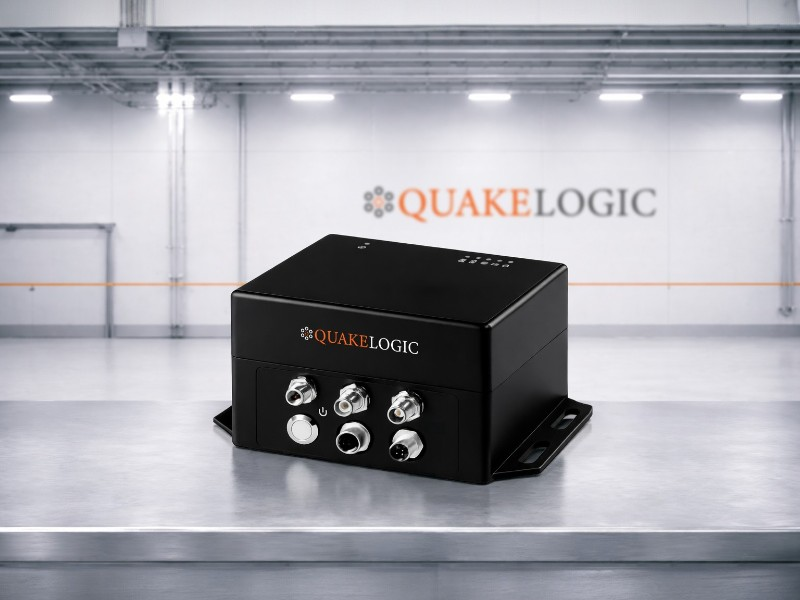
Acoustic emission monitoring listens for transient elastic waves released when material changes occur, such as crack growth, friction, or fatigue activity. Sensors convert those events into signals that engineers can time-align, review, and interpret alongside the asset and operating conditions.
For structural health monitoring, AE is useful when the question is whether an active process is occurring—not merely whether a structure is moving. A complete system needs sensor coupling, independent channel triggering, dependable timing, noise-control planning, and engineering interpretation.
QL-SeismoSense uses independent multi-channel acquisition. A modular MASTER/SLAVE arrangement supports scaling as the monitored area grows.
The integrated FPGA performs real-time processing at the recorder. It extracts event and crack-progression indicators including b-value, βt, and cumulative counts, so an engineering team can receive time-relevant indicators without depending on continuous transfer of every raw signal. The algorithms were developed with Politecnico di Torino and are patented.
QL-SeismoSense includes software for macOS, Windows, and Linux with no separate software-license requirement. The software is ready for pressure-vessel inspection workflows and supports rectilinear and orthogonal coordinate systems, together with the signal-processing toolbox required to review AE data.
For pilot deployments and critical equipment where a defined sensor set supports focused monitoring.
Configure an 8-channel QL-SeismoSense systemFor plant-wide or distributed structural monitoring requiring more simultaneous sensor inputs.
Configure a 16-channel QL-SeismoSense systemFor inspection work where the system is moved between assets or test locations.
Discuss a portable QL-SeismoSense configurationMonitor AE activity associated with crack development in steel bridge elements.
Support structural-health monitoring plans where active material change is an engineering concern.
Use synchronized AE data as part of a damage-assessment workflow.
Monitor acoustic activity in geotechnical and mining environments.
Evaluate pumps, motors, gearboxes, and valves for active AE events.
Record multi-channel AE data during controlled materials testing.
| Channels | 4, 8, or 16; modular MASTER/SLAVE architecture |
|---|---|
| Sampling performance | 1.25 MS/s at 18-bit; 5 MS/s at 16-bit |
| Signal processing | Integrated FPGA architecture |
| Synchronization | Integrated GPS receiver; <1 µs with GPS synchronization |
| Communications | Ethernet, Wi-Fi, optional cellular |
| Compute & storage | ARM processor, embedded Linux, 128/256 MB RAM, 32/64 GB industrial flash storage |
| Power | 9–28 V DC; <10 W for 8-channel configuration |
| Enclosure & environment | IP68 anodized aluminum; −40 °C to +85 °C |
| Dimensions & weight | 17 × 13 × 13 cm; approximately 2.5 kg |
See configurations, component prices, and the QL-SeismoSense datasheet.
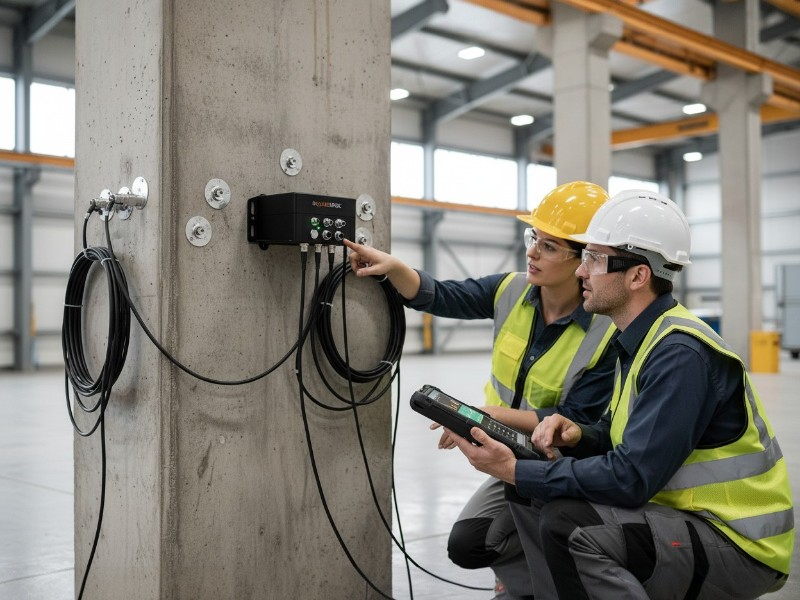
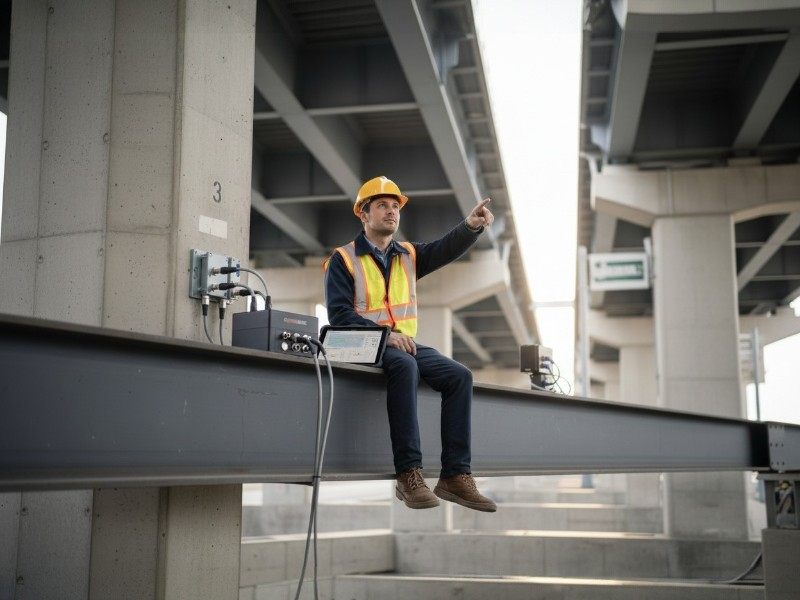
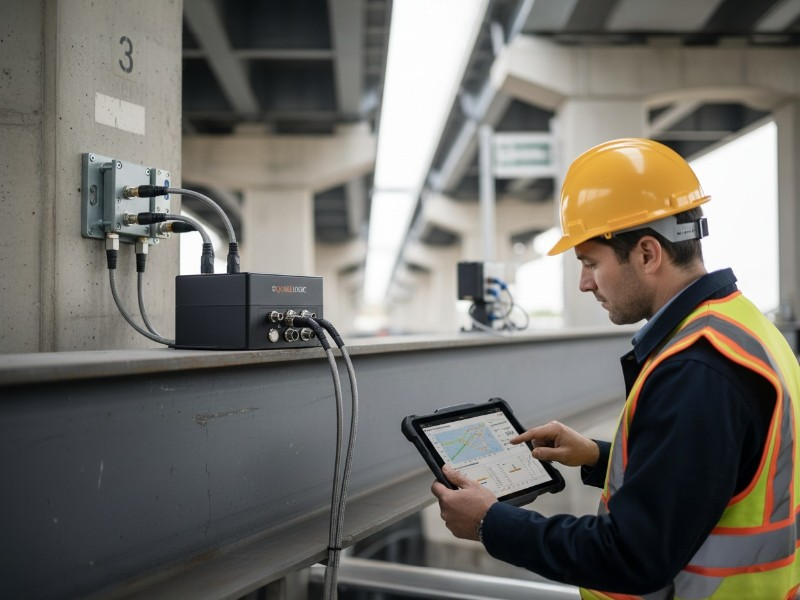
The IAEA selected QuakeLogic to supply a 16-channel AE monitoring system. Read the portfolio case study.
Field validation was completed in the MONFRON project, funded by Regione Toscana, Italy.
Patented FPGA algorithms for crack-progression indicators were developed with Politecnico di Torino.
Roseville, California; ISO 9001:2015, ISO 14001:2015, and ISO 45001:2018; California-certified small business.
The required sensor count depends on the girder geometry, material, expected source locations, attenuation, access, and the monitoring objective. Start with a sensor-layout review rather than assuming channel count alone determines coverage. QuakeLogic can configure QL-SeismoSense as a 4-, 8-, or 16-channel system.
AE monitoring detects transient elastic waves associated with active material processes. Vibration monitoring measures motion response. The methods can complement each other, but they answer different engineering questions and require different sensors, trigger settings, and interpretation methods.
The recorder accepts 9–28 V DC and the 8-channel configuration is specified at less than 10 W. Solar feasibility depends on the full site load, communications, storage, duty cycle, and local environmental conditions; confirm the complete power budget with QuakeLogic.
b-value is an AE analysis indicator used to examine the distribution of event amplitudes. It is not a stand-alone damage decision. QL-SeismoSense can extract b-value, βt, and cumulative counts at the edge for use within an engineering interpretation workflow.
QL-SeismoSense includes an integrated GPS receiver and is specified for less than 1 µs accuracy with GPS synchronization. This supports time alignment and event correlation across synchronized monitoring channels.
Yes. Ethernet and Wi-Fi are integrated; cellular communication is optional. The system provides web-based remote monitoring, remote management, alarm management, and remote firmware updates.
The product is configured from an AE recorder, AE sensors, sensor cables, and AE software. The final bill of materials should be reviewed against sensor layout, cabling distance, environmental conditions, power, telemetry, and software requirements.
Review QL-SeismoSense configurations and component pricing, or ask QuakeLogic to scope an AE deployment. For planning guidance, read the Acoustic Emission Monitoring Guide, the Structural Health Monitoring Systems Architecture, or the Earthquake Early Warning Systems Architecture.
Tell me what you’re building. I’ll help you find products, compare options, and explore engineering applications.

