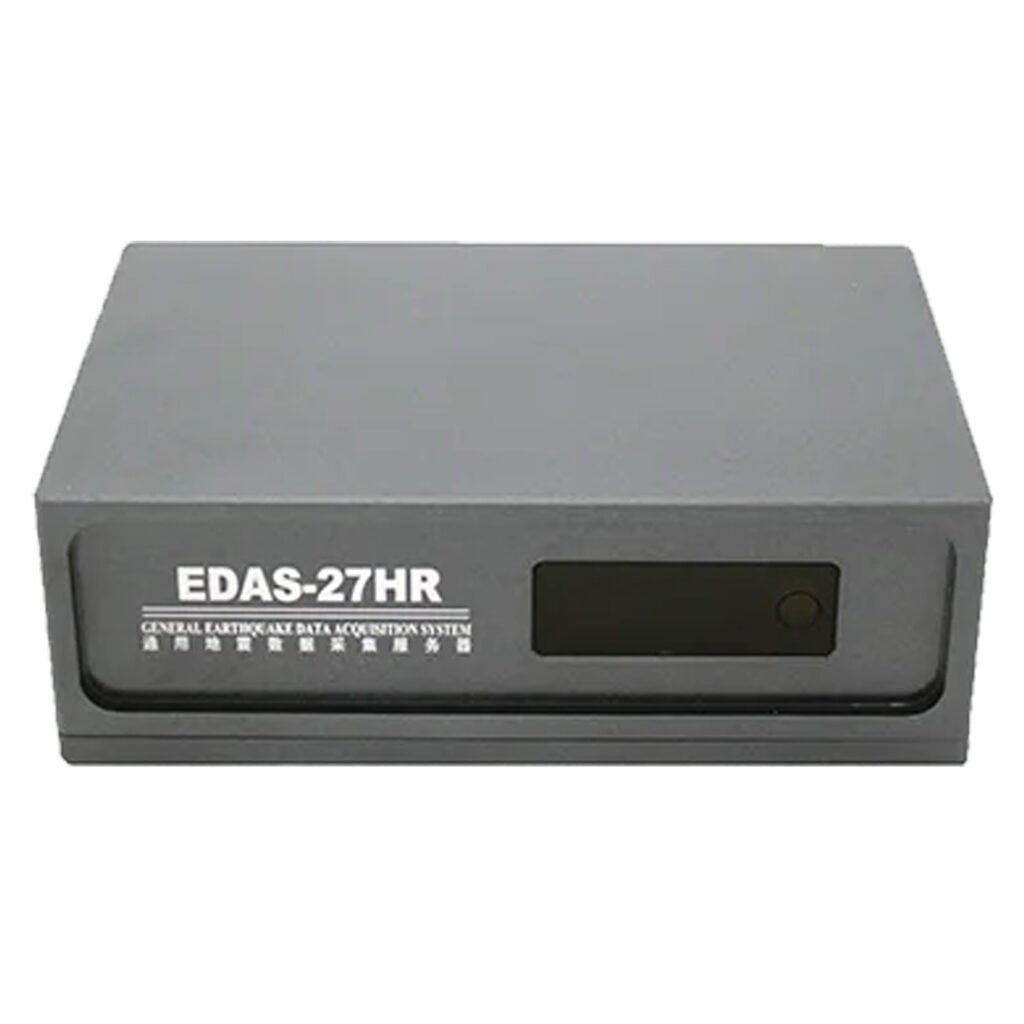
EDAS-27HR
High Resolution Earthquake Data Acquisition Server
EDAS- 27 HR universal seismic data collector can be widely used in monitoring, flow observation seismic observation, seismic monitoring, reservoir dam structure , scientific array, reservoir induced earthquake research, mine seismic monitoring and urban active fault detection wait for the field.
OVERVIEW
Description
The EDAS-27HR is a universal seismic data acquisition system featuring three ultra-high-resolution channels, three high-resolution channels, and a large dynamic range. It delivers low-latency real-time data streams and is specifically designed for use in seismic observation stations, earthquake early warning systems, and integrated seismic monitoring networks. When paired with low-noise seismometers, it forms an extended dynamic range seismic observation system. The device converts multiple analog voltage inputs into digital outputs, supporting data acquisition, recording, and network/serial port transmission. Its compact design and lightweight construction enable seamless integration with various sensors—from broadband seismometers and short-period seismometers to strong-motion accelerometers— comprehensively meeting diverse seismic observation requirements. The EDAS-27HR configuration includes 6 highspeed acquisition channels and 6 auxiliary data acquisition channels. Channel A operates at ±20V with dual-ended balanced configuration Analog differential input; Channel B: ±2.5V, ±5V, ±10V or ±2 0V, balanced differential input.

The EDAS-27HR instrument supports simultaneous output of data at multiple sampling rates (1, 2, 10, 20, 50, 100, 200, 500) .It can store continuous data from two sampling rates simultaneously.Featuring TCP/IP-based networking capabilities, the device enables remote parameter configuration, data transmission, firmware updates, and communication protocols tailored for seismic industry applications. An external OLED display shows real-time instrument status, while built-in touch buttons allow screen activation and memory card removal.
Technical Parameter
Number of data acquisition channels:
-
6 high-speed acquisition channels
-
6 auxiliary data acquisition channels
Seismic data acquisition channel:
-
Differential input; B channel: ±2.5V, ±5V, ±10V or ±20V, double-ended balanced differential input
-
Input signal full value: A channel: ±20V, double-ended balanced differential input
-
Input impedance: 100KΩ (single side)
-
A/D conversion: 28 bits
-
Dynamic range: channel A >147dB, 0
20Hz; channel B >143dB, 020Hz -
Short circuit noise: A channel: less than 0.6µV (sampling rate of 50Hz, 20V range); B channel: less than 1µV (sampling rate of 50Hz, 20V range)
-
Nonlinear distortion: <-110dB @ sampling rate of 50Hz
-
Crosstalk/passband fluctuation: <-110dB / 0.1dB
-
Out-of-band attenuation: >135dB
-
Digital filter: FIR digital filter, which can be set for linear phase shift and minimum phase shift
-
Output sampling rate: 1, 10, 20, 50, 100, 200, 500, 1000, 2000Hz
-
Multiple sampling rate output: each channel supports multiple sampling rate data output at the same time
-
Signal types: square wave, sine wave, pseudo-random binary code
-
Minimum output interval of real-time data: 10 sampling points/bag (low-latency real-time data is provided for earthquake early warning service)
Calibration signal generator:
-
16-bit DAC, programmed waveform output, current calibration: ±20mA, voltage calibration: ±10V; signal frequency, amplitude and period can be set
Auxiliary acquisition channel:
-
Input impedance: 1MΩ (single side)
-
A/D conversion: 24 bits
-
Dynamic range: >135dB @ 1Hz sampling rate
-
Real-time data output interval: 1 second
-
Local record format: compressed format or precursor instrument data format
Timing:
-
Stability of the base during measurement: 10^-8, when GNSS module is synchronized
-
Timing accuracy: when the GNSS module is synchronized, the clock accuracy is less than 0.1ms
-
Timing accuracy: when the GNSS module is not synchronized, the clock drift is less than 1ms/day
-
Timing input: IRIG-B code time signal, support GPS and Beidou timing system
-
Attachment GNSS module: output IRIG-B code time signal
Communication:
-
Communication interface: two RS232C serial ports, one standard 10M / 100M Ethernet card
-
Communication protocol: supports TCP/IP, FTP, Telnet, HTTP and so on, in line with the seismic industry communication network protocol
Take Notes:
-
Storage media: default 8G / 32G / 64G / 128G storage
-
Local record format: EVT, optional compression format, support Mini SEED format
-
Input signal full value: ±10V, double-ended balanced differential input
-
Recording function: It supports simultaneous recording of continuous data and triggered event data, and can store data at two sampling rates at the same time